Since 2024, the EAA has invited Congress participants to share their views and suggestions concerning diversity, equity and inclusion. The word clouds below provide a visual summary of the themes emerging from these open-text responses. They show the relative prominence of themes within each year rather than the absolute frequency of responses across years.
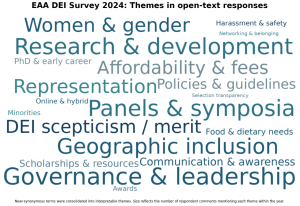
2024
Responses covered a comparatively broad institutional agenda. Governance and leadership, the composition of panels and symposia, research and professional development, geographic inclusion, representation, and gender were particularly visible. Respondents also raised the affordability of participation, policies and guidelines, scholarships and resources, food and dietary needs, and questions of harassment and safety. The responses were not uniform: some participants also questioned the emphasis placed on DEI or argued for a stronger focus on merit.
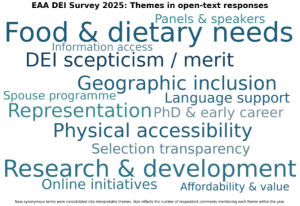
2025
The comments became more focused on concrete experiences of participation. Food and dietary needs, physical accessibility, geographic inclusion and representation appeared alongside research development, language support, transparency in selection processes, and access to information. Respondents also mentioned support for PhD and early-career scholars, online initiatives, and the diversity of panels and speakers. As in 2024, the responses also included critical or sceptical views of DEI initiatives.
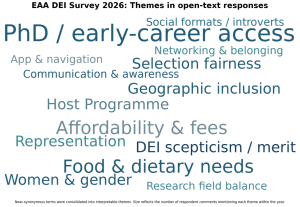
2026
Access for PhD and early-career researchers became particularly prominent, together with affordability, fair selection processes, geographic inclusion, representation, and food and dietary needs. The Host Programme was explicitly identified as a positive mechanism for creating a welcoming environment. Other comments concerned networking and belonging, gender balance, communication, and practical issues such as programme navigation. The separate 2026 question on barriers to participation reinforces several of these themes, with respondents additionally identifying conference fees, childcare, dietary requirements, website and system usability, and crowded networking conditions.
Across the three years, a broader pattern is visible. The 2024 responses concentrated substantially on the institutional architecture of DEI—representation, governance, leadership, panels and policies. In 2025 and especially 2026, attention increasingly turned toward the practical conditions that enable people to participate: affordability, accessibility, selection processes, early-career opportunities, food, networking and belonging. Geographic and financial access recur across the period, while questions of representation increasingly intersect with access to specific opportunities.
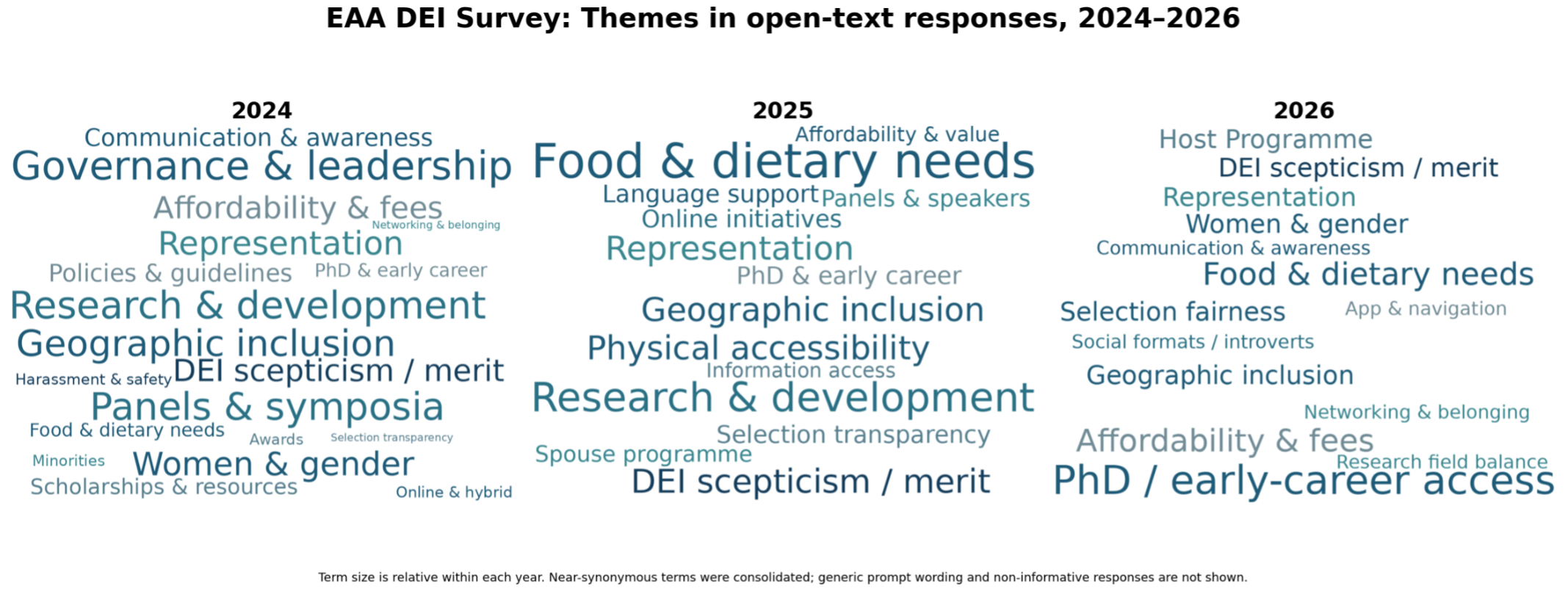
About the visualisation. The clouds are based on the comparable open-ended DEI suggestions question in the 2024, 2025 and 2026 Congress surveys. The fields contained 144 non-empty responses in 2024, 50 in 2025 and 107 in 2026. Generic survey terms such as “EAA”, “DEI”, “diversity”, “equity” and “inclusion”, together with non-informative responses such as “No”, “None” and “N/A”, are not visualised. Closely related terms have been consolidated into common themes, and each respondent contributes at most one mention to a given theme. Term size therefore represents the relative prominence of a theme within that year and should not be interpreted as an absolute comparison of response volume between years. Critical and sceptical comments about DEI have been retained. The visualisations are descriptive summaries of the open-text evidence rather than a substitute for formal qualitative analysis.